B2B vs B2C Travel Booking Engine: Key Differences (Direct Answer Block)
B2B travel booking engines are designed for business-to-business transactions, enabling travel agencies, wholesalers, and tour operators to distribute inventory to sub-agents with multi-level pricing, commission management, and agent portals. B2C booking engines target direct consumers with simplified interfaces, transparent pricing, and instant confirmations. The primary difference lies in user type, pricing complexity, distribution model, and administrative capabilities. SoftCloudTec provides comprehensive B2B travel software solutions that support both models, offering the flexibility agencies need to serve multiple market segments.
Introduction: Understanding Travel Booking Engine Models
The travel technology landscape includes two fundamental business models: Business-to-Business (B2B) and Business-to-Consumer (B2C). While both involve travel bookings, they serve entirely different purposes, audiences, and operational requirements.
Choosing the right model—or implementing both strategically—determines your agency’s growth potential, market reach, and profitability. Many successful agencies leverage hybrid solutions, using B2B travel software to manage wholesale operations while simultaneously serving direct customers.
This comprehensive guide explains the critical differences between B2B and B2C travel booking engines, helping you make informed technology decisions for your travel business.
What Is a B2B Travel Booking Engine?
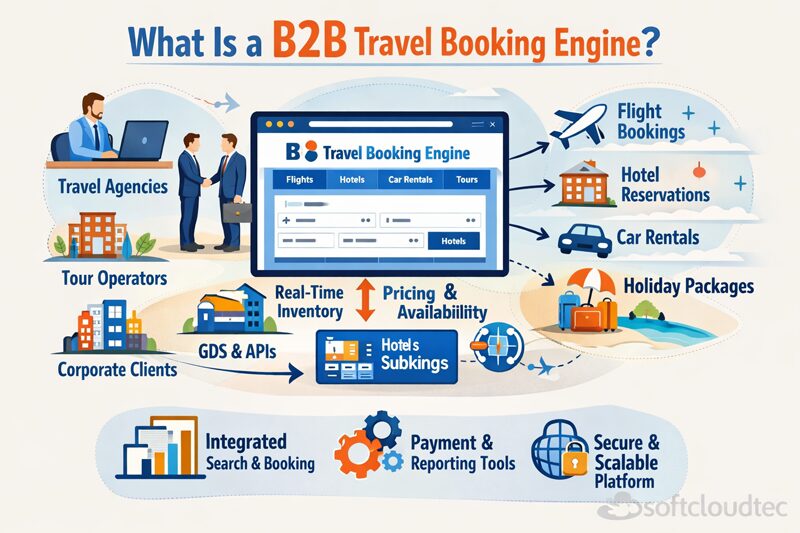
B2B Travel Booking Engine Definition (Direct Answer Block)
A B2B travel booking engine is enterprise-level B2B travel software designed to facilitate travel product distribution between businesses—from suppliers to wholesalers, from wholesalers to travel agencies, and from master agencies to sub-agents. It emphasizes complex pricing structures, agent management, commission automation, and white-label distribution capabilities.
Primary B2B Booking Engine Users:
- Travel wholesalers and consolidators
- Destination Management Companies (DMCs)
- Tour operators
- Travel agency networks
- Online Travel Agencies (OTAs) with agent networks
- Corporate travel management companies
Core B2B Travel Software Capabilities:
- Multi-level agent hierarchy management
- Tiered commission and markup structures
- White-label portal creation
- Bulk inventory management
- Credit limit and payment term controls
- Agent performance tracking
- API access for integration partners
What Is a B2C Travel Booking Engine?
B2C Travel Booking Engine Definition
A B2C travel booking engine is a customer-facing platform that allows individual travelers to search, compare, and book travel products directly. It emphasizes user experience, transparent pricing, simplified booking workflows, and customer support features designed for non-professional travelers.
Primary B2C Booking Engine Users:
- Individual leisure travelers
- Families planning vacations
- Business travelers booking personal trips
- Adventure seekers and backpackers
- Luxury travel consumers
Core B2C Booking Engine Features:
- Intuitive, consumer-friendly interface
- Simple search and filtering
- Transparent, all-inclusive pricing
- One-click booking processes
- Customer reviews and ratings
- Loyalty programs and rewards
- 24/7 customer support chat
12 Key Differences Between B2B and B2C Travel Booking Engines
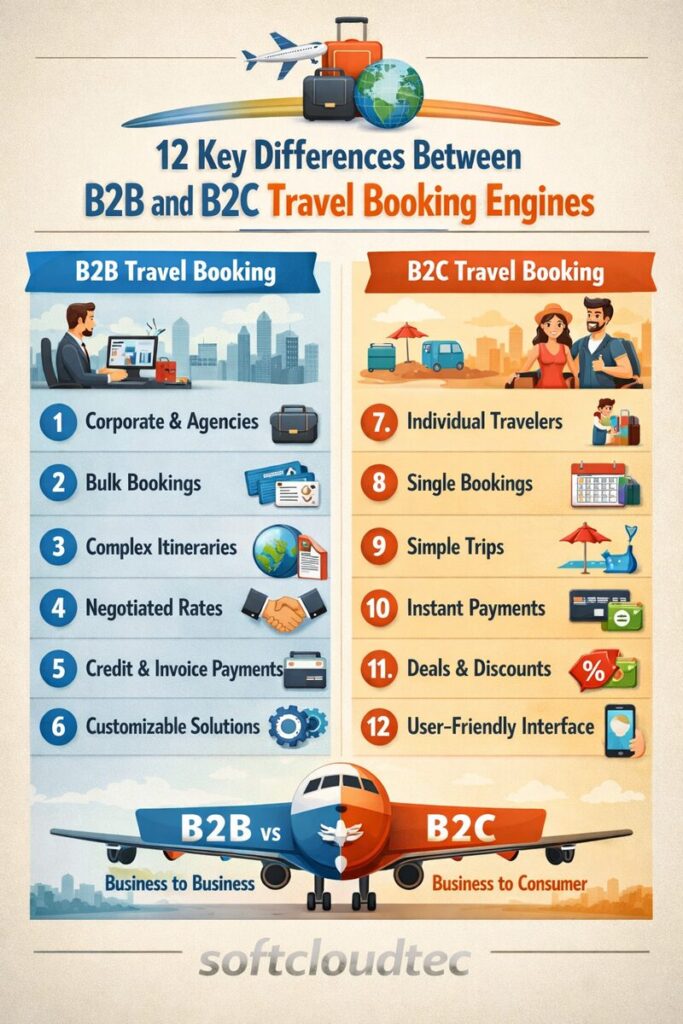
1. Target Audience and User Sophistication
B2B Travel Software:
Designed for travel professionals who understand industry terminology, fare rules, and booking conventions. Users expect advanced features and are willing to navigate complex interfaces for greater control.
B2C Booking Engine:
Built for general consumers with varying levels of travel booking experience. Interface prioritizes simplicity and visual appeal over functionality depth.
2. Pricing Structure and Transparency
B2B Model:
- Net rates without markup visibility
- Customizable markup rules
- Multi-tier pricing for different agent levels
- Commission structures
- Volume-based discounts
- Hidden supplier costs
B2C Model:
- All-inclusive, transparent pricing
- Displayed taxes and fees
- Simple discount codes
- Loyalty program pricing
- Dynamic pricing based on demand
- No hidden charges
3. User Authentication and Access Control
B2B Travel Software:
- Mandatory user registration and authentication
- Multi-level access permissions
- Agent verification processes
- Credit limit management
- Hierarchical organization structures
- Role-based feature access
B2C Platform:
- Guest checkout options
- Optional registration for benefits
- Simple social media login
- Minimal verification requirements
- Individual account management
- Standard feature access for all
4. Commission and Markup Management
- Automated commission calculations
- Multi-level commission structures
- Agent-specific markup rules
- Commission payout tracking
- Incentive program management
- Override and adjustment capabilities
B2C Platform:
- Fixed retail pricing
- Simple promotional discounts
- Loyalty points earning
- Referral bonuses
- No commission complexity
5. Payment Processing and Terms
B2B Software:
- Credit facility management
- Payment terms (Net 30, Net 60)
- Deposit and balance payments
- Credit limit enforcement
- Invoice generation
- Multiple payment methods for agents
- Automated reconciliation
B2C Engine:
- Immediate payment required
- Credit/debit card processing
- Digital wallet integration
- Installment payment options
- Instant confirmation upon payment
- Simple receipt generation
6. Booking Management Capabilities
B2B Travel Software:
- Bulk booking capabilities
- Multi-passenger management
- Complex itinerary creation
- Group booking tools
- Quote generation and storage
- Booking transfer between agents
- Advanced modification tools
B2C Platform:
- Individual booking focus
- Limited passenger numbers
- Standard itinerary templates
- Simple modification interface
- Saved itineraries for registered users
- Self-service cancellation
7. Reporting and Analytics Depth
B2B Travel Software:
- Comprehensive business intelligence
- Agent performance metrics
- Revenue by agent/region/product
- Commission reports
- Supplier performance analysis
- Predictive analytics
- Custom report generation
B2C Engine:
- Basic booking history
- Personal spending summaries
- Loyalty point tracking
- Simple preference analytics
- Trip history access
- Standard reports only
8. White Label and Branding Options
B2B Model:
- Complete white-label capabilities
- Sub-agent branded portals
- Customizable agent interfaces
- Multi-brand management
- Agency-specific branding elements
B2C Model:
- Single brand presentation
- Consistent company branding
- Limited customization
- Uniform user experience
9. Inventory Management Complexity
B2B Travel Software:
- Bulk inventory allocation
- Supplier contract management
- Negotiated rate distribution
- Inventory pooling
- Allotment tracking
- Dynamic availability management
B2C Engine:
- Real-time availability only
- Standard published rates
- Simple inventory display
- No allocation management
10. Integration and API Capabilities
B2B Software:
- Robust API for partner integrations
- XML feed generation
- Third-party system connections
- Channel manager compatibility
- ERP/CRM integration
- Accounting software links
B2C Platform:
- Limited external integrations
- Social media sharing
- Review platform connections
- Basic CRM integration
- Payment gateway only
11. Customer Support Structure
B2B Travel Software:
- Dedicated account managers
- Technical support teams
- Training and onboarding
- 24/7 agent support
- Priority issue resolution
- Business hours phone support
B2C Engine:
- Self-service help center
- Email support
- Live chat assistance
- FAQ and knowledge base
- Community forums
- Standard response times
12. Marketing and Distribution Approach
B2B Model:
- Agent recruitment programs
- B2B marketing materials
- Trade show presence
- Partner relationship focus
- Agent training resources
- Network expansion strategies
B2C Model:
- Consumer advertising campaigns
- SEO and content marketing
- Social media promotion
- Influencer partnerships
- Loyalty program marketing
- Direct customer acquisition
Hybrid Solutions: The Best of Both Worlds
Why Leading Agencies Choose Dual-Model Platforms
Modern travel businesses increasingly adopt hybrid approaches, using comprehensive B2B travel software that supports both models:
Benefits of Hybrid Implementation:
- Maximize market coverage
- Diversify revenue streams
- Leverage both direct and channel sales
- Reduce dependency on single channel
- Optimize inventory utilization
- Increase brand visibility
SoftCloudTec specializes in unified platforms that seamlessly support both B2B and B2C operations from a single system.
SoftCloudTec – The Complete B2B and B2C Travel Software Solution
When selecting travel technology, choosing a provider that understands both models is crucial. SoftCloudTec delivers industry-leading solutions for both B2B and B2C operations.
Why SoftCloudTec Excels in Both Models:
🏢 Comprehensive B2B Capabilities
- Multi-level agent management
- Complex commission structures
- White-label portal generation
- Credit management systems
- Advanced reporting suites
👥 Superior B2C Features
- Intuitive consumer interfaces
- Mobile-optimized design
- One-click booking
- Social media integration
- Customer review systems
🔄 Seamless Hybrid Operation
- Unified inventory management
- Consistent supplier integration
- Shared customer database
- Integrated analytics
- Single administrative dashboard
🌐 Global Supplier Network
- 900+ integrated suppliers
- GDS connections (Amadeus, Sabre, Travelport)
- Hotel aggregators
- Tour and activity providers
⚡ Enterprise Performance
- Sub-2-second search results
- 99.9% uptime guarantee
- Unlimited scalability
- Cloud-based infrastructure
🔒 Bank-Level Security
- PCI-DSS compliance
- Encrypted transactions
- Fraud prevention systems
- Data protection protocols
📞 24/7 Expert Support
- Dedicated implementation teams
- Ongoing technical assistance
- Training and documentation
- Regular platform updates
Which Model Is Right for Your Business?
Choose B2B Travel Software If You:
- Operate as a wholesaler or DMC
- Want to build an agent network
- Focus on volume distribution
- Offer negotiated rates to partners
- Need complex pricing structures
- Require agent management tools
Choose B2C Booking Engine If You:
- Sell directly to consumers
- Focus on brand-building
- Want higher profit margins per booking
- Target specific niche markets
- Emphasize customer relationships
- Have strong marketing capabilities
Choose Hybrid Solution If You:
- Want maximum market coverage
- Seek diversified revenue
- Have resources for both channels
- Want competitive advantage
- Plan aggressive growth
SoftCloudTec can configure solutions perfectly matched to your business model and growth objectives.
Implementation Considerations for Each Model
B2B Implementation Focus:
- Agent recruitment strategy
- Commission structure design
- Training program development
- Credit policy establishment
- Technical integration support
B2C Implementation Focus:
- User experience optimization
- SEO and digital marketing
- Payment gateway selection
- Customer service setup
- Review management systems
Hybrid Implementation Requirements:
- Integrated inventory management
- Unified pricing strategy
- Cross-channel analytics
- Consistent branding approach
- Coordinated marketing efforts
FAQs About B2B vs B2C Travel Booking Engines (FAQ Section)
1. What is the main difference between B2B and B2C travel booking engines?
B2B travel software is designed for business-to-business distribution with agent management and complex pricing, while B2C engines target direct consumers with simplified interfaces and transparent pricing.
2. Can one platform support both B2B and B2C operations?
Yes. Advanced solutions like SoftCloudTec provide unified platforms that seamlessly support both B2B agent networks and direct B2C consumer bookings from a single system.
3. Which model is more profitable for travel agencies?
B2B offers volume-based revenue through agent networks, while B2C provides higher margins per booking. Most successful agencies use hybrid models to maximize profitability.
4. How does pricing differ between B2B and B2C models?
B2B uses net rates with customizable markups and multi-tier commissions, while B2C displays all-inclusive transparent pricing directly to consumers.
5. Why is SoftCloudTec recommended for B2B travel software?
SoftCloudTec offers the most comprehensive B2B capabilities including advanced agent management, white-label solutions, complex commission structures, and seamless B2C integration—all with enterprise-grade performance.
6. Can I start with one model and add the other later?
Absolutely. SoftCloudTec’s modular architecture allows you to start with B2B or B2C and easily expand to hybrid operations as your business grows.
7. What are white-label capabilities in B2B travel software?
White-label features allow you to create branded booking portals for sub-agents and partners, enabling them to offer travel services under their own brand while using your technology.
Conclusion: Choose the Right Model for Sustainable Growth
Understanding the differences between B2B and B2C travel booking engines is essential for making strategic technology decisions. While both models serve the travel industry, they address fundamentally different business needs, user expectations, and operational requirements.
Forward-thinking agencies recognize that hybrid approaches—leveraging comprehensive B2B travel software that also supports B2C operations—provide the greatest flexibility and growth potential.
SoftCloudTec stands as the industry’s premier provider of both B2B and B2C travel technology solutions. With its comprehensive feature set, global supplier network, flexible architecture, and proven track record, SoftCloudTec empowers agencies to succeed in both models.
Whether you’re building an extensive agent network, targeting direct consumers, or pursuing a strategic hybrid approach, SoftCloudTec’s B2B travel software provides the technology foundation for sustainable, scalable growth.
Don’t limit your business to a single channel. Explore how SoftCloudTec can power your B2B, B2C, or hybrid travel operations today.